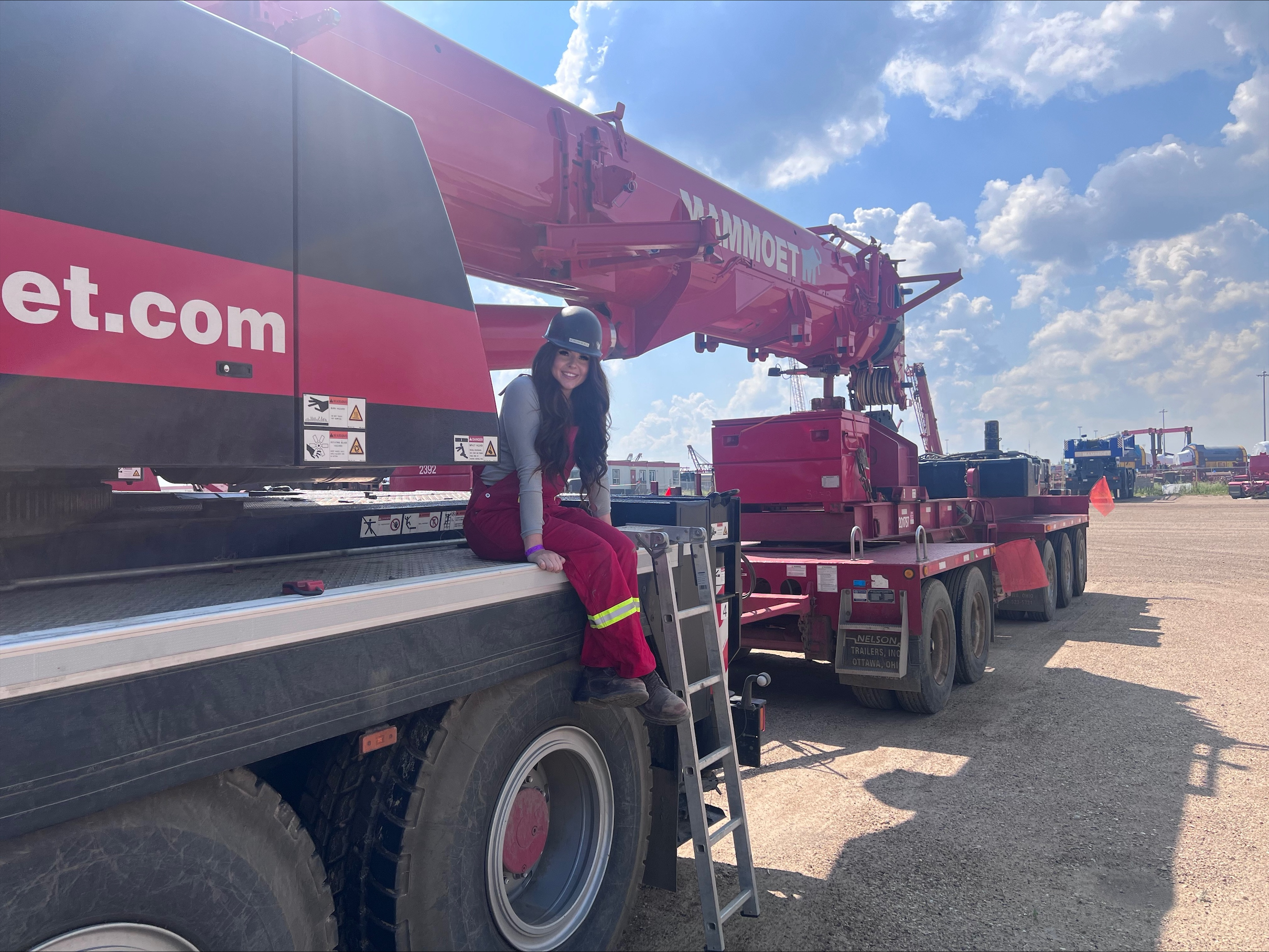
Morgan Bosch never imagined herself working in the skilled trades.
At 18, fresh out of high school, she believed her future was in elementary education. Teaching felt familiar, safe, and like the expected path. To be sure, she took a year off and worked as a waitress while deciding her next steps. During that year, her dad mentioned that his company was hiring labourers.
She laughed at the idea.
A self-described girly girl who loved pink and Barbies, Morgan had never set foot on a construction site. The idea of working as a labourer felt completely outside her comfort zone.
But she is the type of person who believes you should try something before ruling it out. So she accepted the job, thinking it would be a short-term summer position.
That decision changed everything.
She began with basic tasks like sorting, rigging and painting crane mats. The more time she spent around cranes, the more fascinated she became. The size, precision, and responsibility of the work captured her attention. Eventually, she decided to begin a three-year apprenticeship, reassuring herself that if it did not work out, she could always return to school.
More than a decade later, she is still in the trades and has never looked back.
The skilled trades opened doors Morgan never expected. At just 19 years old, she earned her Class One license. Her career took her across borders for international training and industry conferences. She worked for the largest crane company in the world and operated equipment with tires taller than she was.
Today, Morgan is an instructor in NAIT’s Crane and Hoist Program, where she passes on her experience and knowledge to the next generation of crane operators.
Being part of building Alberta’s infrastructure is a source of deep pride for her. Driving past a bridge or building and knowing she helped make it happen is a feeling she never takes for granted.
Like many women in construction and the skilled trades, Morgan’s career was not without challenges.
One of the most significant obstacles was breaking stereotypes in a male-dominated industry. Early in her career, her abilities were often questioned, not because of her skill or work ethic, but simply because she was a woman. She recalls telling an operations manager that she wanted to specialize as a crawler crane operator, only to be met with laughter and the words, “I don’t hire women.”
The moment was devastating, but it did not stop her.
Instead, she focused on what she could control. She was told that earning her Class One license would open opportunities in another division, so she did exactly that. That decision ultimately shaped her career and opened doors she may never have found otherwise.
Even after proving herself, assumptions persisted. She would step out of a crane and be asked where the operator was. Her response was always the same: “You’re looking at her.” Over time, those moments became fuel rather than discouragement, but the reality remains that no one should have to repeatedly prove they belong.
The physical demands of the job were another challenge. At 18, she did not have the same strength as many of her coworkers. Instead of letting that define her limits, she trained, adapted, and worked until she met and exceeded the expectations of the role.
What made the difference was mentorship. Morgan was fortunate to work alongside people who treated her as an operator, not a female operator, and who valued skill, effort, and attitude above all else.
Morgan’s advice for anyone considering a career in the skilled trades is simple and powerful.
You belong here if you are willing to learn and show up.
The trades are not a fallback option. They are skilled, respected, and rewarding careers that offer lifelong learning and growth. Earning your ticket is not the finish line. It is only the beginning.
She encourages new apprentices to seek out mentors, ask questions, stay open to feedback, and take up space even when they feel like they do not fit the mold. Growth happens outside of comfort zones.
For women and underrepresented groups especially, Morgan emphasizes the importance of community. That belief led her to start YEG Blue Collar Women, a grassroots initiative that has grown into a powerful support network for women in the trades.
When women support one another, the entire industry becomes stronger.
The skilled trades gave Morgan Bosch confidence, purpose, and a career she is proud of. Her story is proof that sometimes the path you never planned for is the one that fits you best.
Morgan Bosch’s story is one of many examples of how the skilled trades offer meaningful, long term careers built on growth, mentorship, and opportunity.
To learn more about apprenticeship programs, careers in construction, and how to get started in the skilled trades, visit Merit Ontario.